How Shared Household Customs Take Shape
Household traditions rarely begin with a grand plan. They grow from small, repeatable actions that people find welcoming, useful or simply pleasant—and can change as the household does.
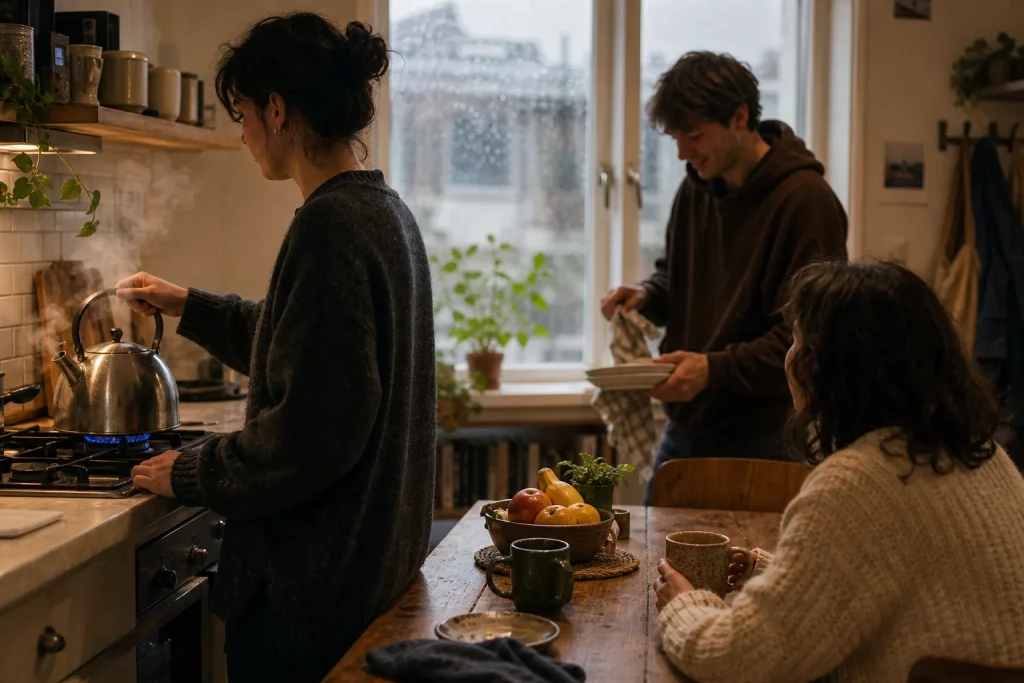
On a rainy Thursday, someone puts a pot of tea on while a housemate clears the table. The next week, the kettle goes on again before anyone asks. A small habit has begun to carry a little meaning: it signals a pause, a chance to sit together, and a familiar way to end the day.
That is often how a household custom takes shape. It does not need a name, a special occasion or agreement from everyone at once. Repeated actions become traditions when people recognise them, take part by choice and find something worth keeping in them. The useful question is not how to create a perfect ritual, but what kind of repeated moment would suit the people who live together.
Repetition gives an ordinary action meaning
A household routine is usually a practical action repeated to get something done: putting shoes by the door, taking turns with the bins or eating at a similar time. A custom has an additional social layer. The action becomes a familiar signal or shared expectation. Setting out a bowl of fruit after the weekly shop may start as convenience; if everyone comes by to choose something and chat, it can become a small point of connection.
The distinction is not fixed. A routine can gain meaning, and a custom can remain useful. Some families fold laundry together because the task goes faster; others treat the time as a chance to talk. The same action can serve different purposes for different people, so it helps to notice what participants actually value rather than assigning meaning on their behalf.
Customs also depend on repetition that fits real life. An elaborate meal that requires one person to shop, cook and clean may be difficult to sustain. A simple habit—such as everyone choosing a song while dinner is prepared—asks little of the household and leaves room for different kinds of participation.
Small cues make a custom easier to repeat
Most recurring actions attach to something already happening. A cue can be a day of the week, a familiar place, an object or a point in an existing routine. For example, a household might have a short check-in while putting away groceries, or make Sunday breakfast the moment to choose meals for the coming days. Connecting a new custom to an established event makes it easier to remember without relying on one person to announce it each time.
Keep the first version modest. Decide what happens, when it happens and what counts as taking part. “We sit down for a drink after the Saturday market” is clearer and easier to adapt than “we should spend more quality time together.” The custom can be brief, and it need not happen if someone is tired, away or busy.
Make the invitation easy to accept or decline. A teenager might join a shared dessert but skip the conversation; a housemate might contribute a playlist rather than sit at the table. Participation does not have to look identical for everyone. If the custom only works when all participants act in the same way, it may be too rigid for the household.
Agree on the meaning instead of assuming it
People can experience the same ritual differently. A weekly meal may feel warm to one person and like an obligation to another. A tidy-up before guests arrive may be satisfying for one resident but stressful for someone who needs more time. Ask open, low-pressure questions: “Would you enjoy doing this again?” “What part feels good?” “Is there anything we should change?” Those prompts invite a real answer without making enthusiasm a test of belonging.
Shared customs work best when the effort and the benefit are not silently assigned to one person. If one resident always remembers, prepares and cleans up, what looks like a collective tradition may actually be unpaid coordination. Divide the small tasks, rotate them, or simplify the custom. A tradition can be meaningful without being elaborate, and it should not depend on someone carrying a hidden workload.
Boundaries matter, too. A custom should not require personal disclosure, physical affection, spending money or eating particular foods. Offer alternatives that preserve the shared moment without making anyone explain a private reason. For instance, people can join a meal with their own food, or take part in a family call by listening rather than speaking.
Let the custom change with the household
People’s schedules, energy and living arrangements change. A tradition that once suited a household may become awkward when someone starts an evening shift or moves away. Treating the custom as adaptable can protect its purpose. If the point is staying in touch, a rotating voice message might replace a shared Sunday dinner. If the point is welcoming someone home, a note by the door may work better than a fixed gathering.
It is also fine for a custom to end. A gentle check-in can make that choice easier: “Does this still work for us, or should we try something else?” Keep what people want to carry forward and release the parts that now feel like chores. The history of a custom can remain meaningful even when the action changes.
A hypothetical example of a new household custom
Imagine three housemates who rarely overlap at dinner. One likes cooking, another works late, and the third prefers not to commit to a fixed meal. They want a small way to share time without adding expense or making anyone wait.
They choose a simple starting point: whenever two or more are home after the weekly grocery run, they put the kettle on and spend a few minutes unpacking together. The person who brings in the bags starts the kettle; anyone who is busy can leave their groceries for later or join without making tea. After a few weeks, they ask whether the arrangement feels useful. If it does, they keep it; if the timing is awkward, they move the pause to another shared moment. The likely tradeoff is modest: it may create an easy opening for conversation, but it will not bring everyone together on every occasion.
The example works because the action is attached to something the housemates already do, asks little of each person and leaves room to opt in differently. A household with different needs could choose another cue, such as watering plants or clearing the table. The important part is not the kettle; it is making a small invitation repeatable without turning it into a rule.
To begin, notice a moment your household already shares, then suggest one small action that could make it more pleasant or connected. Try it without demanding that it become permanent. If people return to it willingly, you have the beginnings of a custom. If they do not, their response is useful information: change the cue, simplify the action or let the idea go.
You might also enjoy
Why Some Everyday Objects Feel Easier to Use
A hypothetical kitchen drawer shows how visibility, clear feedback and comfortable handling can make an everyday…

How to Build a Flexible Pantry for Weeknight Cooking
Take stock before you shop, choose versatile staples that suit your routine, and use them to…