Why Some Everyday Objects Feel Easier to Use
A hypothetical kitchen drawer shows how visibility, clear feedback and comfortable handling can make an everyday routine easier to follow.
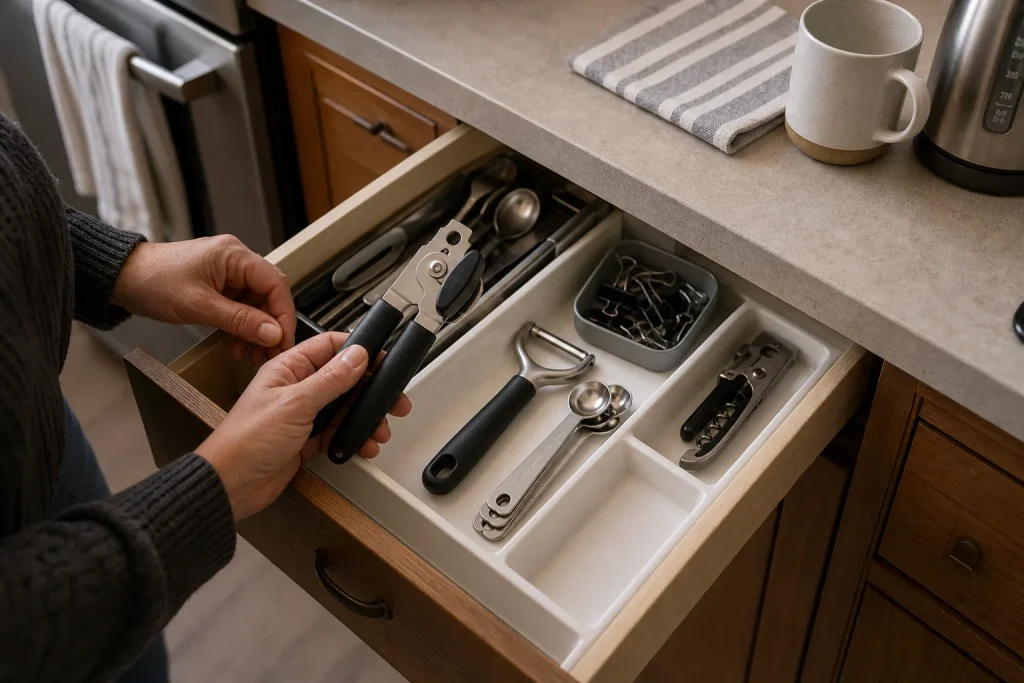
A kitchen drawer sticks halfway open, its contents rattle, and the can opener has slipped beneath a pile of utensils. Nothing is broken, but making tea or preparing lunch keeps involving the same small search. In a hypothetical household, that drawer offers a practical way to see why some everyday objects feel intuitive and others ask for extra effort.
The point is not to make every possession sleek or replace useful things. Notice how an object communicates: Can you see what it is for? Does it show what happens when you use it? Can you hold and operate it comfortably? Visibility, feedback and handling can help explain friction in an ordinary routine. They also offer clues when choosing, arranging or adapting household objects.
Describe the awkward moment before changing anything
Imagine a fictional household with two adults who cook in a compact kitchen. The drawer nearest the counter holds a can opener, vegetable peeler, measuring spoons, corkscrew and loose clips. The tools overlap. The opener has dark handles, and the drawer lining is dark too. Its working end is hidden, so someone reaching in may not spot it.
Rather than jumping to a purchase, the household describes the problem precisely: “I cannot see the opener before I reach in, and I have to move other tools to take it out.” That identifies two sources of friction: poor visibility and blocked access. A general complaint such as “the drawer is annoying” does not point as clearly to a useful change.
Use the same method with other objects. A soap dispenser may be hard to operate because its pump gives no clear indication that it is locked. A chair may feel awkward because its arms obstruct the table. A jar may be hard to open because the lid offers little grip. Notice the moment of hesitation, extra movement or uncertain handling instead of assuming the user needs to pay closer attention.
Then distinguish essentials from occasional tools. The measuring spoons may be used often, while the corkscrew is used less frequently. The aim is to make common actions easier without making less-used objects impossible to reach.
Make the useful part visible without creating a hazard
Visibility means relevant information or a useful part of an object can be noticed when needed. It does not mean everything must be fully exposed. A clear measuring cup makes its contents and markings visible. A contrasting switch can stand out against a lamp base. A distinct handle can be easier to locate among similar shapes.
In the hypothetical drawer, the household removes the loose clips and sorts the tools by frequency of use. The can opener and peeler go near the front, with their handles facing upward and clear of one another. The rarely used corkscrew moves to a separate utensil container. A pale, removable drawer liner contrasts with the opener’s dark handles.
These changes do not require a label for every item or turn the drawer into a display. They make it easier to recognize and grasp the needed tool. A similar adjustment might be to turn a kettle’s water-level window outward, store a frequently used mug with its handle reachable, or place a salt cellar where it can be seen from the work surface.
Visibility has limits. Do not leave a sharp blade exposed just to make it easy to see. Medication may require secure storage, and children’s access matters in a family kitchen. Follow product instructions and use sound judgment about safe storage. For a safety or health decision that is unclear, ask an appropriate qualified professional.
Look for feedback that confirms an action
Feedback is the signal an object gives while or after someone uses it. A lid that clicks into place, a latch that visibly closes or a measuring spoon with a clearly marked size tells the user something happened. Without a clear signal, a person may repeat an action, use extra force or wonder whether the object is ready.
In the invented kitchen, the can opener has a small locking lever. The people using it have not agreed on how it should be stored, so sometimes the lever is left engaged and sometimes it is released. One person pulls the handles; another tries to turn the knob first. The tool works, but its state is not obvious at a glance.
The household checks the maker’s instructions and adopts one storage habit: release the lever after use, then place the opener with its knob visible. This does not change the tool. It makes its condition easier to read and gives the next person a useful cue. If the lever still feels unclear, they avoid forcing it and consult the instructions rather than guessing.
Feedback can be visual, audible or tactile. A kettle’s switch may move into a different position; a cabinet catch may make a soft click; a hand mixer’s control may have distinct settings. The useful cue depends on the object and its setting. A loud sound may disturb a sleeping household, while a subtle mark may be hard to see in dim light.
When choosing between similar objects, ask whether the action and its result are easy to distinguish. Does a container show when it is closed? Can you tell which way a handle turns? Does a control make its selected position apparent? A clear cue reduces uncertainty without demanding constant attention.
Choose a comfortable way to hold and operate an object
Comfortable handling involves grip, balance, reach, resistance and the force an action seems to require. A broad handle may be easier to grasp than a narrow, slick one. A knob where the hand naturally rests may be simpler to turn than one tucked behind a pot.
In the hypothetical drawer, one household member has stiff fingers in the morning. The can opener’s smooth, narrow handles are difficult for them to pinch together, especially when the tool is crowded by neighboring utensils. Instead of squeezing harder, the household clears space around the handles and tries the opener at the counter, where both hands can approach it.
That adjustment may make the task more manageable, but it will not suit everyone. If the opener remains painful or difficult to control, the household can compare models with larger, textured handles and a turning mechanism suited to the user. They can inspect the grip and controls in a shop or consult product information about how the tool is held and operated.
For persistent pain or a significant limitation, avoid treating an object change as a diagnosis or a substitute for care. A qualified health professional can assess the person’s needs; an occupational therapist may advise on adapting everyday tasks and objects. Seek advice that fits the individual, especially if symptoms are new, worsening or interfering with daily activities.
The same attention applies to ordinary choices: a broom’s handle should suit the person using it; a vegetable peeler should feel stable rather than slippery; a laundry basket should have handholds that allow a balanced lift. People differ, so “comfortable” is not one shape or material. Let the actual user handle the object when possible, and notice awkward wrist positions, pinching or repeated readjustment.
Change one friction point before replacing everything
Design improvements need not begin with shopping. In the imagined kitchen, the household first changes the drawer arrangement, clears space around the opener and agrees on how to leave its lever. These reversible choices address the problems they identified. If the tool still does not suit the person using it, replacement becomes a more informed decision.
A new object can inherit the same problem. A larger opener buried beneath utensils may still be hard to find. A container with a clever lid may be uncomfortable for someone with a limited grip. Consider the full interaction: where the object lives, how someone notices it, how they use it and what signals completion.
Ask the people who actually perform the task. One person may value quick access; another may need secure storage. A layout that works for one person can create an obstacle for another. Try a reversible adjustment—moving an item, changing its orientation or adding a removable liner—and observe whether the intended cue becomes clearer in ordinary use.
- Check whether the needed tool is visible before reaching in; if it is hidden, move it toward the front, otherwise leave its position unchanged.
- Check whether another item blocks the tool’s handle; if access is blocked, separate the items, otherwise keep the current spacing.
- Check whether the tool’s working end or controls are easy to identify; if they blend into the drawer, add safe contrast or change orientation, otherwise avoid adding visual clutter.
- Check whether the opener’s lever state is clear after use; if it is ambiguous, consult the maker’s instructions and agree on a storage position, otherwise retain the established routine.
- Check whether the person can grip and operate the opener without pain or loss of control; if not, stop forcing the action and consider another suitable tool or qualified advice, otherwise continue with the current tool.
- Check whether a proposed change creates a storage or safety problem; if it exposes a sharp edge or makes secure storage harder, choose a safer arrangement, otherwise try the reversible adjustment.
A worked hypothetical example of a crowded opener drawer
Starting inputs: In this invented household, a can opener sits in a deep drawer with dark utensils. Its handles are hard to see, a peeler lies across them, and one user finds the narrow grip uncomfortable. The drawer also needs to hold measuring spoons and clips. The household wants to understand the problem before buying an organizer. These details are hypothetical, not observations from a real household.
Actions and decisions: First, the household removes the tools and sorts them into frequently used and occasional items. It keeps the measuring spoons and opener close to the counter, moves the less-used corkscrew to a secondary container, and puts the clips together rather than leaving them loose. Next, it places the opener near the drawer front with handles facing up, removes the peeler from across them and adds a light, removable liner. It checks the opener’s instructions, then agrees to release the lever after use and leave the knob visible. Finally, the user handles the opener at the counter. If the grip remains uncomfortable or difficult to control, the household stops expecting storage changes to solve the fit problem and compares other suitable tools or seeks qualified advice.
Expected result and tradeoff: The opener should be easier to spot and grasp, and its resting state should be clearer to the next person. The drawer will hold fewer seldom-used tools, so the corkscrew will be less convenient to reach. If the grip remains uncomfortable, another tool may be needed. The changes address access and clarity, but do not erase every limitation.
Ease of use is a relationship between a person, an object and the place where an action happens. When something feels awkward, look for a hidden working part, a missing cue or an uncomfortable grip. Make a small change that addresses the specific friction, then check whether the intended action is clearer. If it is not, that result helps distinguish a storage problem from an object that may not suit the person.
You might also enjoy

How Shared Household Customs Take Shape
Household traditions rarely begin with a grand plan. They grow from small, repeatable actions that people…
How to Build a Flexible Pantry for Weeknight Cooking
Take stock before you shop, choose versatile staples that suit your routine, and use them to…